
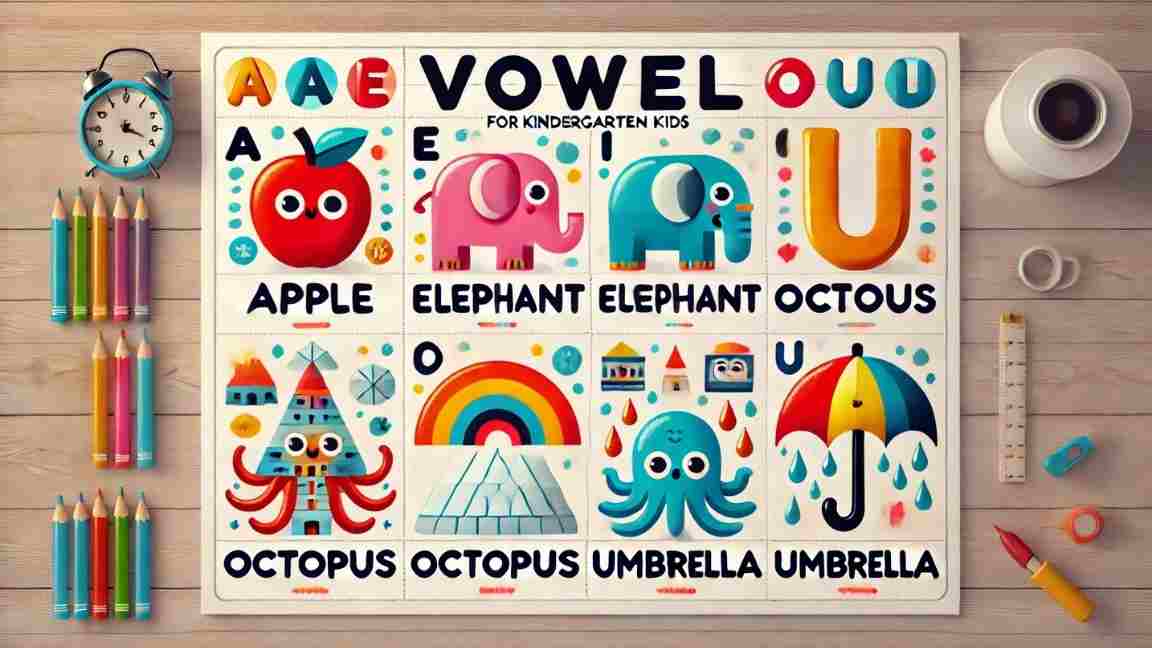
As a kindergarten teacher, I’ve come to realize that teaching children the basics of language is one of the most crucial steps in their early education. One of the most important concepts they need to understand is vowels. A vowel chart for kindergarten can be an excellent visual tool for helping children learn vowels, associate them with sounds, and begin reading and writing.
In this article, I’m going to share the best vowel charts for kindergarten, describe each chart in detail, and explain how to use them effectively. I’ve found these charts not only useful but also engaging for children, so I want to share my experiences with you.
Vowel Chart for Kindergarten
1. Classic Vowel Chart with Pictures
This is one of the most popular vowel charts for kindergarten. It features the five vowels (A, E, I, O, U) alongside pictures of objects that start with each vowel. For example, “A” is represented by an apple, “E” by an elephant, “I” by an ice cream, and so on. This chart is very colorful and visually stimulating, making it easy for young learners to remember each vowel sound.
How to use it:
- Start by pointing to the letter on the chart.
- Say the letter sound out loud.
- Encourage children to repeat after you.
- Show the picture next to the letter and say the word.
- Repeat the process several times, engaging the children by asking them to point to the letters.
Personal experience: When I used this chart with my class, the children responded very positively. They enjoyed identifying the pictures, and it helped them associate sounds with images, which made learning much easier and fun.
2. Vowel Chart with Color-Coded Letters
This vowel chart for kindergarten uses color-coding to distinguish the vowels from consonants. Each vowel is given a unique color, which helps children visually separate vowels from other letters. This chart is excellent for visual learners.
How to use it:
- Point to each vowel and say its name and sound.
- Ask the children to repeat after you.
- Show the children how each vowel is highlighted in a different color.
- Encourage them to find and point to the vowels in a group of mixed letters.
Personal experience: I found that children were able to recognize vowels more easily with this chart because of the distinct color differentiation. It became a fun game to spot the vowels in worksheets, and it reinforced their learning quickly.
3. Interactive Vowel Chart
This type of vowel chart for kindergarten is an interactive tool where children can lift flaps or use magnets to reveal pictures and sounds associated with each vowel. The chart can be hung on the wall, and the children can interact with it during lessons.
How to use it:
- Display the chart where all the children can see it.
- Ask the children to come up one by one and lift the flap or move the magnet to reveal the vowel and corresponding image.
- As each vowel is revealed, say its sound together.
- Have children repeat the sound and name of the object pictured.
Personal experience: This chart worked wonders for hands-on learners. The interactive feature kept the children engaged, and the act of physically interacting with the chart helped them remember the vowel sounds better.
Also Read: Preschools in Firozabad
4. Vowel Chart with Phonetic Symbols
This vowel chart for kindergarten includes the phonetic symbols for each vowel sound. While this might sound advanced for younger learners, it can be an excellent way to start introducing them to phonetic transcription, especially for children who are already familiar with letter names and sounds.
How to use it:
- Introduce the vowel sounds using the phonetic symbols.
- Explain each symbol and its corresponding vowel sound.
- Use the chart to compare different vowel sounds and their variations.
- Encourage children to pronounce words that use those sounds.
Personal experience: Although it was initially a bit complex for some, I found that children who had a good grasp of the basic sounds responded well to this chart. It provided them with a more precise understanding of vowel sounds.
5. Vowel Sound Chart with Rhyming Words
This vowel chart for kindergarten focuses on rhyming words, showing how vowels change the sounds of different words. For example, “cat,” “bat,” and “rat” all have the same vowel sound, but the vowel “a” can change in other words, such as “cap” and “map.”
How to use it:
- Show the words on the chart with the same vowel sound.
- Ask children to say the words aloud together.
- Introduce new rhyming words and ask children to identify the common vowel sound.
- Encourage children to come up with additional rhyming words on their own.
Personal experience: This chart helped the children understand how vowels work within different words and reinforced their ability to recognize rhyming patterns. The children loved it, and it significantly improved their phonemic awareness.
6. Vowel Sound Wheel Chart
The vowel sound wheel chart is a circular chart where each vowel is placed in a separate segment, and the chart rotates to show different vowel sounds. This chart works well for interactive learning sessions.
How to use it:
- Rotate the wheel to reveal a vowel sound.
- Say the sound and encourage the children to repeat after you.
- Show the corresponding word and picture.
- Let the children take turns rotating the wheel.
Personal experience: The rotating feature of this chart made the learning process feel like a game. The children were excited to take turns and interact with the chart, which kept them engaged and motivated.
7. Vowel Song Chart
This vowel chart for kindergarten integrates a simple vowel song, with the vowels and associated images. Singing the vowel song with children is a great way to reinforce learning.
How to use it:
- Sing the vowel song together, pointing to each vowel on the chart as you sing.
- Repeat the song several times until the children can sing along.
- Ask children to make up their own words using the vowels.
Personal experience: Children really enjoyed singing the vowel song, and it made the vowel sounds much easier for them to remember. The song format helped the children retain the information in a fun and engaging way.
Also Read: Preschools in Hisar
8. Vowel and Consonant Comparison Chart
This chart contrasts vowels with consonants, which helps children better understand the difference between the two. It shows examples of words that start with vowels and consonants.
How to use it:
- Point out the vowel and consonant sounds in each word.
- Compare words with vowels and consonants.
- Ask children to come up with their own examples.
Personal experience: I found that comparing vowels and consonants in this way helped children solidify their understanding of vowels and their role in words. It was especially helpful for children who struggled with identifying vowels in words.
9. Vowel Tracing Chart
This vowel chart for kindergarten allows children to trace over the vowels using a finger or a pencil, which is great for motor skills development. The chart often includes dotted lines for each letter to trace.
How to use it:
- Have the children trace the vowels with their fingers or pencils.
- As they trace, say the vowel sounds together.
- Repeat the tracing several times for reinforcement.
Personal experience: The tracing activity helped children with their handwriting skills, and they seemed to enjoy the tactile experience. It was a great way to combine phonics with fine motor practice.
Also Check: School Parent app
10. Vowel Sound Sorting Chart
This chart allows children to sort words by vowel sounds. It can be a fun way for children to practice categorizing and identifying different vowel sounds.
How to use it:
- Show a list of words and ask children to sort them based on the vowel sound.
- Encourage the children to say the words aloud as they sort them.
- Provide plenty of opportunities for children to practice sorting with new words.
Personal experience: Children loved this sorting activity, and it really helped them focus on the subtle differences in vowel sounds. It was an interactive way to reinforce vowel knowledge and build phonological awareness.
Conclusion
Incorporating a vowel chart for kindergarten into your classroom can be a game-changer for young learners. Each of these charts serves a unique purpose, helping children to learn vowels in different, engaging ways. As a kindergarten teacher, I’ve seen firsthand how these charts can make a significant impact on students’ understanding of language and reading skills.
By using these vowel charts for kindergarten, children not only learn to identify vowels but also develop phonemic awareness and improve their reading and writing abilities. I highly recommend trying these charts in your classroom or at home with your child!
Also Read: Preschool Vowels Worksheets for Kindergarten