
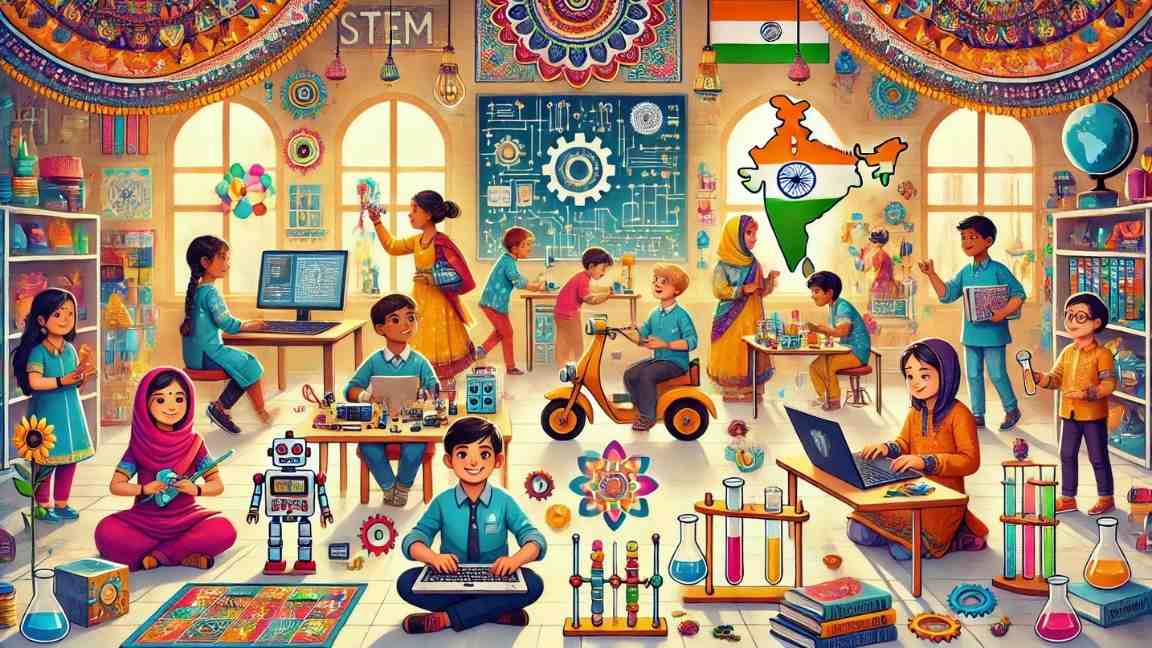
STEM Education for Kids in India: A Complete Overview
In today’s fast-evolving educational landscape, STEM education for kids (Science, Technology, Engineering, and Mathematics) has emerged as a cornerstone for shaping young minds. In India, where education often relies heavily on traditional rote learning methods, STEM provides a refreshing, hands-on, and interdisciplinary approach. It empowers children with critical thinking, problem-solving abilities, and creativity from an early age. This article delves deeply into what STEM education is, its significance for children in India, its benefits, challenges, and practical implementation.
What is STEM Education for Kids?
STEM education combines the disciplines of Science, Technology, Engineering, and Mathematics into an integrated learning model. Unlike the traditional siloed approach, STEM focuses on real-world applications, fostering curiosity and innovation among young learners. For kids, it transforms abstract concepts into tangible experiences, such as building models, conducting experiments, or programming simple robots.
In essence, STEM makes learning fun, interactive, and purposeful, ensuring children not only acquire knowledge but also learn to apply it effectively.
Importance of STEM Education for Kids in India
India stands at the forefront of global technological and scientific advancements. For the country to maintain its edge in innovation, early exposure to STEM education is vital. Here’s why STEM education for kids is crucial in India:
1. Preparing for a Technology-Driven Future
With advancements in artificial intelligence, robotics, and biotechnology, STEM equips kids with the foundational skills to excel in these fields.
2. Encouraging Creativity and Innovation
STEM challenges children to think critically and explore unconventional solutions, fostering a culture of innovation.
3. Global Competitiveness
Countries worldwide are prioritizing STEM education. To ensure India’s next generation remains globally competitive, early STEM exposure is essential.
4. Reducing Gender Disparities
STEM initiatives specifically target encouraging girls to explore STEM fields, breaking stereotypes and fostering gender equality.
5. Developing Problem-Solving Skills
From building a simple bridge model to solving coding puzzles, STEM nurtures logical thinking and decision-making.
Also Check: Preschools in Ramanagara
Core Components of STEM Education
1. Science
Introduces kids to the wonders of the natural world through experiments and observations.
- Activities: Growing plants, understanding weather patterns, and exploring the solar system.
2. Technology
Teaches kids about digital tools, programming, and innovation.
- Activities: Basic coding games, creating digital art, or building simple circuits.
3. Engineering
Focuses on design and construction, encouraging kids to solve practical problems.
- Activities: Building bridges with blocks or designing toy cars.
4. Mathematics
Develops numerical literacy and logical thinking.
- Activities: Patterns, puzzles, and geometry-based games.
Benefits of STEM Education for Kids
1. Hands-On Learning
Interactive activities ensure that kids grasp concepts better than theoretical methods.
2. Enhances Curiosity
STEM feeds a child’s natural curiosity, prompting them to ask questions and seek answers.
3. Builds Resilience
STEM projects often involve trial and error, teaching kids to learn from failures and persevere.
4. Encourages Teamwork
Group activities in STEM projects foster collaboration and communication among children.
5. Improves Academic Performance
STEM’s interdisciplinary approach reinforces classroom concepts, making learning cohesive and impactful.
Also Check: Preschools in Ramanagara
How to Implement STEM Education for Kids in India
1. STEM Labs in Schools
Many progressive schools in India are establishing STEM labs equipped with tools like 3D printers, robotics kits, and interactive software.
2. Home-Based Learning
Parents can encourage STEM learning at home using DIY kits, science experiments, or coding apps.
3. Workshops and Camps
Organizations like Robokidz and Tinkerly conduct workshops that introduce kids to robotics, coding, and engineering.
4. Online Platforms
Apps and websites like BYJU’S, WhiteHat Jr., and Scratch provide easy access to STEM-based learning modules.
5. Extracurricular Clubs
Schools and communities can organize STEM clubs where kids collaborate on projects, participate in competitions, and share ideas.
Challenges in STEM Education for Kids in India
Despite its benefits, implementing STEM education for kids in India faces several hurdles:
1. Accessibility Issues
STEM resources are often limited to urban areas, leaving rural children with fewer opportunities.
2. High Costs
STEM kits, gadgets, and programs can be expensive, making them inaccessible for many families.
3. Lack of Trained Educators
To effectively teach STEM, teachers require specific training, which is currently insufficient.
4. Overemphasis on Academics
India’s education system traditionally prioritizes theoretical knowledge over practical skills, which hampers STEM adoption.
Also Check: School Parent app
Best Resources for STEM Education for Kids
1. STEM Kits
- Smartivity
- Butterfly EduFields
- LittleBits Kits
2. Books
- National Geographic Science Experiments
- Coolest Simple Science Projects
3. Apps
- Scratch
- Tynker
- BYJU’S Coding Classes
4. Workshops
- Robokidz
- STEMpedia
Personal Experience with STEM Education
As a parent and educator, I introduced my son Aarav to STEM education for kids through a simple science kit that involved building a volcano model. Watching his excitement as the “lava” erupted was a joyful experience. He became curious about chemical reactions and started experimenting with safe household items. His school projects improved, and he expressed a newfound interest in science.
Similarly, my niece Aarushi enjoyed coding using the Scratch platform. She created a simple game where a cat catches a ball, showcasing creativity and logical thinking.
These experiences proved how engaging STEM education can be, not just for learning but for sparking lifelong curiosity and skills.
Conclusion
STEM education for kids in India is more than a trend—it’s a necessity for the modern age. By introducing STEM concepts early, parents and educators can nurture a generation of innovators, thinkers, and problem-solvers. Whether through school labs, online platforms, or DIY kits, the opportunities for STEM learning are endless.
If you’re looking to prepare your kids for a bright future, start incorporating STEM education into their daily activities today. Let’s make learning exciting, purposeful, and transformative!
Also Read: Preschool STEM Programs