
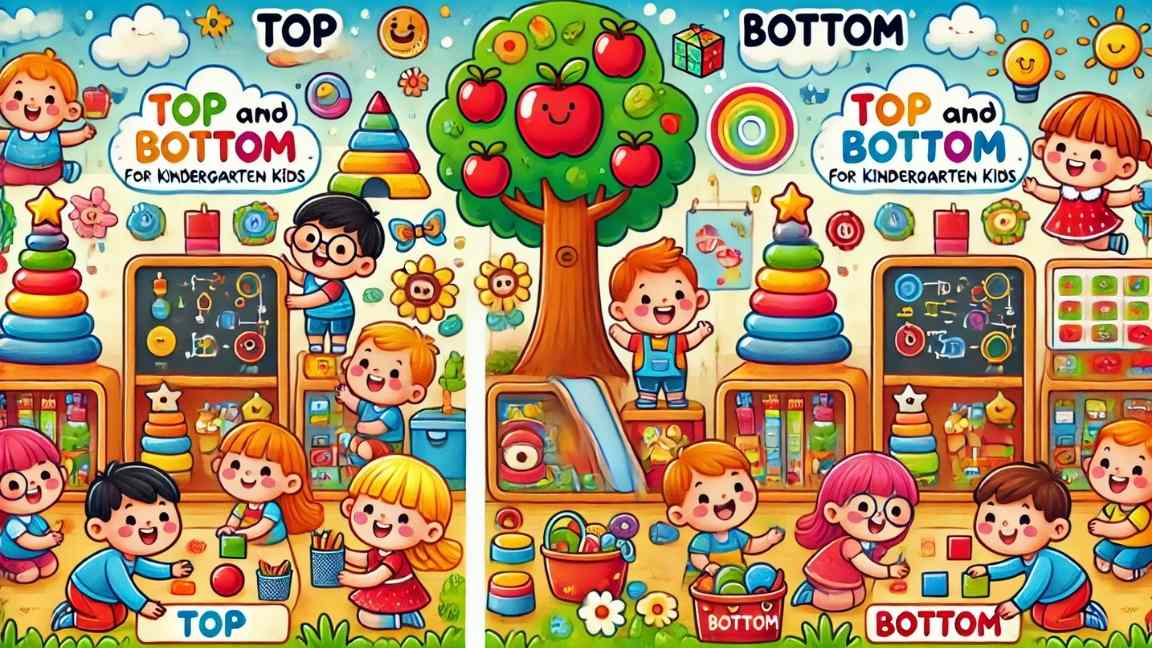
Introducing the concepts of “top” and “bottom” to kindergarten kids is an essential part of their spatial awareness development. When children understand these basic positional terms, it helps them build a foundation for more complex concepts in mathematics, language, and daily interactions. Here are 10 engaging and deeply informative top and bottom activities for kindergarten that will make the learning process enjoyable and meaningful for kids.
Top and Bottom Activities for Kindergarten
1. Real-Life Object Sorting
Description:
This activity involves using everyday objects to help children distinguish between what belongs on the “top” and what goes on the “bottom.” By working with items they encounter in their daily lives, kids can relate these spatial concepts to the world around them.
How to Conduct:
- Gather objects such as a tree model (with leaves for the top and roots for the bottom), a toy house (roof for the top and base for the bottom), and stacked blocks (small blocks for the top, large ones for the bottom).
- Arrange sorting mats labeled “Top” and “Bottom” and have children sort the items accordingly.
- Ask questions like, “Why does the roof go on top?” or “What supports the tree at the bottom?” to prompt deeper thinking.
Why It’s Effective:
Sorting tangible objects helps children understand positional relationships in a hands-on way. It also enhances their observation and reasoning skills.
Personal Experience:
When Aarushi participated in this activity, she was excited to place the tree’s leaves on the “Top” mat and the roots on the “Bottom” mat. She joyfully said, “Roots hold the tree, so they have to stay at the bottom!” Her understanding of the concept amazed her parents.
2. Top and Bottom Treasure Hunt
Description:
This activity transforms learning into an adventure by combining physical movement with the exploration of top and bottom positions. It’s a fun way to get kids engaged and active while reinforcing spatial awareness.
How to Conduct:
- Hide small objects like toy animals, balls, or crayons around the room. Place some on high surfaces (e.g., shelves, tables) and others on the floor or under furniture.
- Provide clues like, “Find the red ball on the top shelf,” or “Search for the blue car at the bottom of the table.”
- Celebrate when children find the objects and discuss their placement.
Why It’s Effective:
This treasure hunt combines movement, problem-solving, and learning, keeping kids physically active while internalizing the concept of “top” and “bottom.”
Personal Experience:
Kabir found a toy giraffe on the top shelf during one treasure hunt and exclaimed, “I looked up high and saw it peeking at me!” His excitement and curiosity made the activity a huge hit among his classmates.
Also Check: Preschools in Kharegaon
3. Drawing Top and Bottom Scenes
Description:
Art activities allow children to visually represent the concept of “top” and “bottom.” Through drawing, they learn to categorize and organize their thoughts while expressing creativity.
How to Conduct:
- Provide children with blank paper divided into two sections: “Top” and “Bottom.”
- Ask them to draw objects typically found at the top (like the sun, clouds, or birds) and the bottom (like grass, flowers, or ants).
- Encourage kids to use bright colors and add details to their drawings.
- Discuss their artwork and ask them to explain their reasoning behind placing certain objects in specific areas.
Why It’s Effective:
This activity fosters creativity while reinforcing spatial awareness. It also helps develop fine motor skills and the ability to organize ideas visually.
Personal Experience:
Meera created a vibrant picture with clouds, a rainbow, and birds at the top, and grass, flowers, and a bunny at the bottom. She proudly said, “This is how the world looks outside my window!” Her classmates were inspired to create similar scenes, making the session both educational and joyful.
4. Role-Playing with Multi-Level Toys
Description:
Using toys with multiple levels, such as dollhouses or construction sets, helps kids understand “top” and “bottom” through imaginative play. This activity is great for group learning and social interaction.
How to Conduct:
- Set up a dollhouse or a multi-level block tower.
- Place toy figures or objects on different levels and ask questions like, “Who is standing at the top floor?” or “What’s at the bottom of the tower?”
- Allow kids to rearrange the toys and describe their new positions, encouraging them to use the words “top” and “bottom” in their explanations.
- Expand the activity by creating stories where characters move between the top and bottom levels.
Why It’s Effective:
Role-playing fosters creativity and contextual learning, helping kids grasp abstract concepts in a tangible and relatable way.
Personal Experience:
Aarav placed a superhero at the top of a Lego tower and said, “He’s keeping an eye on everyone from up there!” His imaginative approach made the activity highly engaging and memorable for the entire group.
Also Check: Preschools in Kharegaon
5. Musical Top and Bottom Actions
Description:
Combining music with physical actions is a great way to make learning interactive. A simple song about “top” and “bottom,” paired with gestures, helps children remember the concepts through repetition and movement.
How to Conduct:
- Create or use a song with lyrics like:
- “Top and bottom, top and bottom,
What’s up high? What’s down low?
Top is where the birds fly,
Bottom is where the grass grows.
Now we know, now we know!”
- “Top and bottom, top and bottom,
- Teach children gestures like pointing up for “top” and down for “bottom” during the song.
- Repeat the song several times, encouraging kids to join in and perform the actions.
Why It’s Effective:
Songs enhance memory retention and allow children to learn concepts while having fun. The physical actions make the learning process even more engaging.
Personal Experience:
The song quickly became a classroom favorite. Aarushi enthusiastically performed the gestures and said, “I’m going to teach this to my little brother!” Parents later mentioned how much their kids loved singing it at home.
6. Building Block Towers
Description:
This activity involves stacking blocks to create towers, allowing children to learn about “top” and “bottom” through hands-on exploration. It also introduces them to concepts of stability and balance.
How to Conduct:
- Provide a variety of building blocks in different shapes and sizes.
- Guide children to build towers by stacking blocks on top of one another.
- Once the towers are built, discuss which blocks are at the top and which are at the bottom.
- Add a fun challenge by asking them to build the tallest or the most stable tower.
Why It’s Effective:
This activity combines learning with play. It enhances motor skills, problem-solving abilities, and an understanding of basic physics.
Personal Experience:
Kabir built a tall tower and confidently said, “The bottom blocks need to be strong to hold everything on top!” His realization of structural balance was a proud moment for both him and me.
7. Nature Walk Exploration
Description:
A nature walk is an excellent way to connect kids with the environment while teaching them about “top” and “bottom.” This activity is educational and relaxing, offering real-world examples of the concept.
How to Conduct:
- Take the kids on a walk through a garden, park, or any green area.
- Ask them to observe and identify things that are on the “top” (like trees, birds, or the sky) and things on the “bottom” (like grass, soil, or rocks).
- Encourage them to collect small items like leaves or pebbles and classify them as “top” or “bottom” objects when they return to the classroom.
Why It’s Effective:
This outdoor activity combines physical activity with sensory learning, helping children relate abstract concepts to their surroundings.
Personal Experience:
On one nature walk, Aarushi pointed to a bird on a branch and said, “That’s at the top of the tree!” Her excitement made the learning process feel effortless and enjoyable.
Also Check: School Parent app
8. Top and Bottom Flashcards
Description:
Using flashcards with images of objects found at the top and bottom is an interactive way to teach this concept. The visual appeal of the cards captures children’s attention and reinforces their learning.
How to Conduct:
- Create or purchase flashcards showing objects commonly found at the top (e.g., sun, clouds, stars) and bottom (e.g., grass, rocks, water).
- Hold up each card and ask children to identify whether it belongs to the top or the bottom.
- Organize the cards into two piles: “Top” and “Bottom.”
- To add fun, turn it into a speed game by timing how quickly they can sort the cards correctly.
Why It’s Effective:
Flashcards are an excellent visual aid, enhancing memory retention and vocabulary development.
Personal Experience:
Meera enjoyed sorting the flashcards and exclaimed, “The stars are always on top at night!” Her excitement was contagious, and other kids eagerly participated in the activity.
9. Shadow Play
Description:
Shadow play is a creative activity where children learn about “top” and “bottom” by observing shadows created with different objects. This activity is both scientific and artistic.
How to Conduct:
- Use a flashlight or a desk lamp in a dim room.
- Have children hold objects like cups, toys, or leaves and project their shadows on a wall.
- Ask them to identify the object (on top) and its shadow (at the bottom).
- Discuss how light creates shadows and why shadows always appear at the bottom of the object.
Why It’s Effective:
This activity introduces basic physics concepts while reinforcing the spatial relationship between top and bottom.
Personal Experience:
Aarav created a shadow of a bird on the wall and said, “The bird’s shadow is at the bottom because the light is shining from the top!” His observation was a wonderful example of practical learning.
10. Top and Bottom Relay Race
Description:
A relay race adds physical activity to the learning process. Children identify and categorize items as “top” or “bottom” while participating in a fun and competitive game.
How to Conduct:
- Set up a relay course with stations containing objects that can be categorized as top or bottom items.
- Divide the kids into two teams and provide them with baskets labeled “Top” and “Bottom.”
- At each station, they pick an object and run to place it in the correct basket.
- The team with the most correctly sorted items wins.
Why It’s Effective:
This activity encourages teamwork, physical fitness, and spatial understanding.
Personal Experience:
Kabir and Aarushi were thrilled to participate in the relay race. Aarushi said, “I love running and finding the right things for the top and bottom baskets!” The competitive element kept all the kids excited and focused.
Conclusion
These top and bottom activities for kindergarten provide a mix of creativity, movement, and hands-on learning, ensuring that children grasp the concept in a fun and meaningful way. From sorting objects and treasure hunts to drawing and role-playing, these activities cater to various learning styles, making them suitable for every child.
In my experience, students like Aarushi, Meera, Kabir, and Aarav enjoyed these activities immensely. Parents were thrilled to see their children applying these concepts in real-life situations. By incorporating these activities into your teaching routine, you can make learning about “top” and “bottom” a delightful and enriching experience!
Also Read: Sports Day Games for Kindergarten